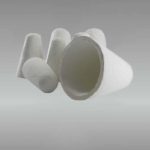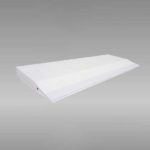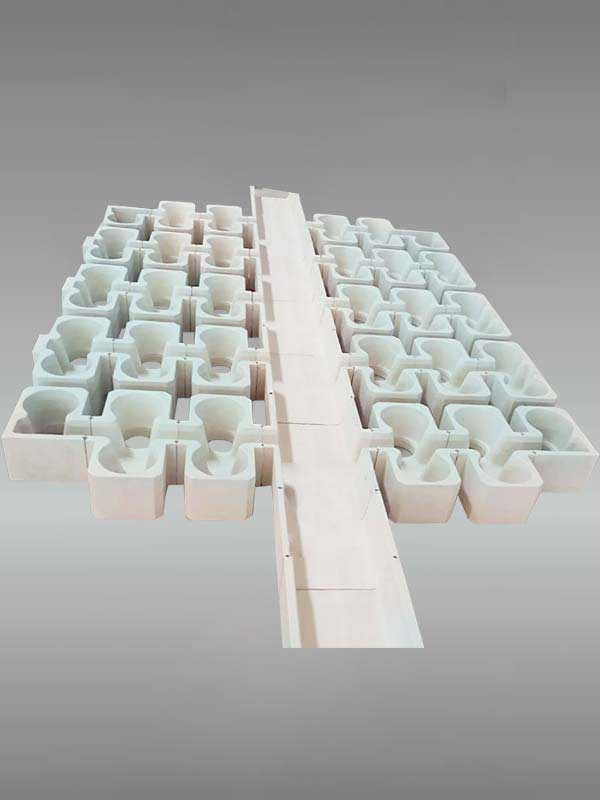
Distributing Launder is an important molten aluminum transfer component used during aluminum and aluminum alloy casting processes.
It controls the flow distribution of molten aluminum on the casting machine platform and is commonly used together with the crystallizer in hot-top casting systems.
The distributing launder is installed between the aluminum casting die plate, diverter plate, and the overall molten metal flow system to ensure smooth and stable molten aluminum transfer during casting.
Stable molten aluminum flow is essential for maintaining uniform solidification conditions and improving aluminum rod quality.
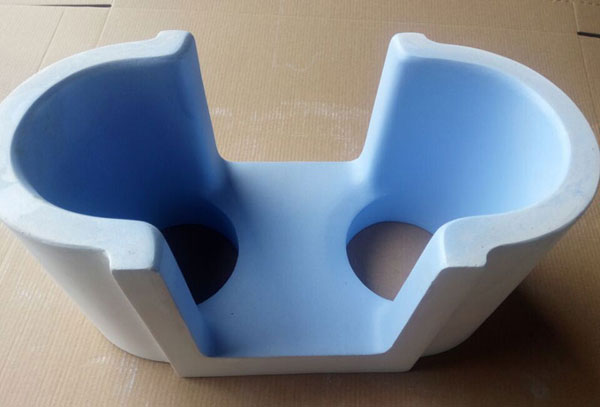
Trough-Type Distributor
Product Specifications
Specification (Based on the alloy diameter)
| 3in | 3.5in | 4.5in | 5in | 5.5in | 6in | 6.5in | 7in |
| 8in | 9in | 10in | 12in | 14in | 16in | 18in | 20in |
Technical parameter
| Item | Denisity (g/cm3) |
Compression Strength (Mpa) |
Thermal Expansivity (X*10-6/℃) |
Max Working Temperature (℃) |
| Index | 1.4-1.5 | 15-16 | 4-4.5 | >1000 |
Request A Quote
Function of Distributing Launder in Aluminum Casting
The main function of the distributing launder is to distribute and stabilize molten aluminum flow before it enters the crystallizer.
It helps:
- Control molten aluminum flow distribution
- Reduce turbulence during casting
- Maintain stable temperature conditions
- Improve molten metal transfer efficiency
- Support uniform aluminum solidification
Without proper molten aluminum distribution, unstable flow may affect crystallization conditions and create casting defects.
Applications of Distributing Launder
Distributing launders are widely used in:
- Aluminum rod casting lines
- Hot-top casting systems
- Aluminum billet casting
- Continuous casting production
- Aluminum alloy casting operations
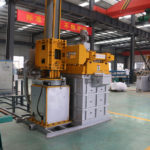
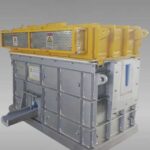
The product is installed on the casting machine platform and works together with the crystallizer and other hot-top casting components.
Product Advantages
Excellent Thermal Insulation Performance
The distributing launder provides good thermal insulation performance with temperature drop controlled within approximately 1℃ per meter.
This helps maintain stable molten aluminum temperature during transfer.
Non-Stick Aluminum Performance
The material structure offers excellent non-stick aluminum properties, helping reduce molten aluminum adhesion and buildup during operation.
Integral Molding Technology
The lining body adopts advanced high-silicon molten material integral molding technology with high dimensional accuracy.
This improves structural stability and casting consistency.
Long Service Life
The normal service life is approximately 180–360 days under standard operating conditions.
The smooth internal surface helps reduce molten aluminum resistance and improve flow stability.
High Temperature Resistance
With a maximum working temperature above 1000℃, the product maintains stable performance during continuous aluminum casting operations.
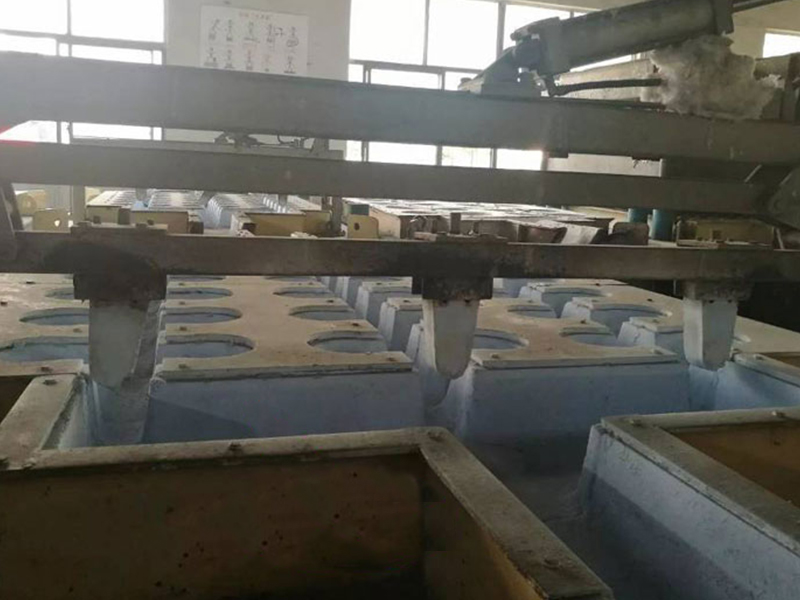
Distributing Launder
High-Silicon Molten Material Technology
The distributing launder adopts a new high-silicon molten material molding technology designed specifically for molten aluminum applications.
Compared with traditional refractory structures, this material offers:
- Better thermal shock resistance
- Improved anti-sticking performance
- Longer operational lifespan
- More stable molten aluminum transfer
- Reduced contamination risk
The integral molding structure also improves dimensional precision and reduces joint-related failure risks.
Importance of Stable Molten Aluminum Flow
In aluminum casting operations, stable molten aluminum flow directly affects:
- Surface quality
- Grain structure
- Internal porosity
- Casting stability
- Product consistency
If molten aluminum flow becomes unstable during transfer, turbulence and temperature fluctuation may occur inside the crystallizer.
This can lead to:
- Surface cracks
- Uneven solidification
- Oxide inclusions
- Poor aluminum rod quality
Distributing launders help maintain stable molten aluminum transfer conditions throughout the casting process.
Request A Quote
Instructions for Hot-Top Casting Series
Step 1 – Select Proper Component Size
Choose the correct distributing launder size according to alloy diameter and casting equipment requirements.
Step 2 – Proper Installation
The distribution plate, thimble, transition plate, distributing launder, and graphite ring are installed above the casting platform.
The thimble, transition plate, and graphite ring are installed below the platform.
All products should remain:
- Smooth
- Clean
- Undamaged
- Seamless
For improved thermal insulation, it is recommended to seal around the side and bottom using ceramic fiber blanket or ceramic fiber paper.
Step 3 – Uniform Preheating
After installation, uniformly preheat the hot-top casting platform to approximately 260℃–350℃.
If electric heating is unavailable, flame heating may be used carefully to remove absorbed crystal water.
Direct flame contact with the lining body is prohibited.
Relationship with Complete Aluminum Melt Treatment System
In modern aluminum casting operations, distributing launders are commonly used together with:
- Inline degassing systems
- Ceramic foam filters
- Pouring cups
- Hot-top casting systems
- Refining flux
- Slagging flux
- Covering flux
Each component helps improve molten aluminum cleanliness, flow stability, and casting consistency.
Why Molten Aluminum Flow Control Matters
Proper molten aluminum flow control improves:
- Casting stability
- Product consistency
- Heat distribution
- Aluminum cleanliness
- Production efficiency
Modern aluminum casthouses increasingly focus on complete molten metal transfer optimization to reduce defects and improve product quality.
Improve Molten Aluminum Flow Stability with AdTech Distributing Launder
Stable molten aluminum transfer is essential for high-quality aluminum casting production.
AdTech Distributing Launder helps control molten aluminum flow, improve thermal insulation performance, stabilize casting conditions, and reduce casting defects in aluminum rod and billet production.
Combined with complete aluminum melt treatment solutions, AdTech distributing launders support cleaner molten aluminum transfer, more stable casting performance, and improved production efficiency.
FAQ
1. What is a distributing launder used for?
A distributing launder is used to control and distribute molten aluminum flow during aluminum casting operations.
2. Where is distributing launder installed?
It is installed on the casting machine platform and used together with the crystallizer.
3. Why is molten aluminum flow control important?
Stable molten aluminum flow helps improve solidification consistency and reduce casting defects.
4. What material is distributing launder made of?
It uses high-silicon molten material with integral molding technology for molten aluminum applications.
5. Does distributing launder provide thermal insulation?
Yes. It offers excellent thermal insulation performance and minimizes temperature drop during molten aluminum transfer.
6. What is the service life of a distributing launder?
Under standard operating conditions, the typical service life is approximately 180–360 days.
7. What temperature can distributing launder withstand?
The maximum working temperature exceeds 1000℃.
8. Can distributing launder reduce casting defects?
Yes. Stable molten aluminum flow helps reduce turbulence, inclusions, and uneven solidification.
9. Is preheating necessary before use?
Yes. Uniform preheating to approximately 260℃–350℃ is recommended before operation.
10. Can distributing launder be used with other melt treatment systems?
Yes. It is commonly used together with degassing systems, ceramic foam filters, pouring cups, and hot-top casting equipment.