Molten aluminum doesn’t sit quietly in a furnace. The moment it reaches liquid state, it starts reacting — with moisture in the furnace atmosphere, with combustion gases, with oxygen. Every minute your melt surface is exposed without protection, you’re losing aluminum to oxidation and picking up hydrogen that will haunt you at the casting station.
Covering flux solves this problem at its source. Applied directly to the molten aluminum surface, it melts rapidly and forms a dense, fluid protective barrier between your metal and the furnace atmosphere. Oxidation slows dramatically. Hydrogen absorption drops. Metal loss — the kind that shows up as heavy dross and inflated melt loss reports — goes down measurably.
AdTech manufactures covering flux formulations for both standard aluminum alloys and high-magnesium / strontium-modified alloys, with all components properly heat-treated to remove adsorbed water and crystal water before packaging. Because moisture in your flux defeats the entire purpose of using flux in the first place.
If your project requires the use of Covering Flux, you can contact us for a free quote.
What Is Covering Flux and What Does It Do?
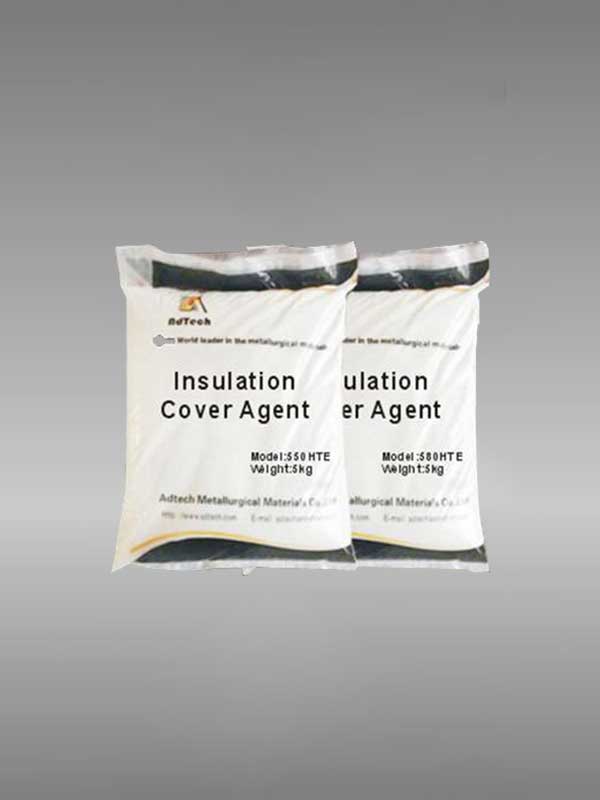
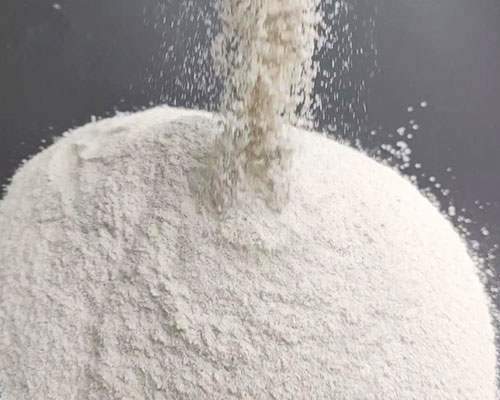
Covering flux is a white powdery material composed of chloride and fluoride salts and other inorganic compounds, specifically formulated to protect molten aluminum alloy surfaces during melting and holding in the furnace. When spread across the melt surface, the covering flux melts at a controlled temperature and flows into a continuous, low-viscosity liquid layer that forms a dense protective film in a short time.
This protective film serves three critical functions:
- Prevents oxidation — Creates a physical barrier between the molten aluminum and oxidizing gases in the furnace atmosphere, dramatically reducing the formation of aluminum oxide (Al₂O₃) dross and oxidized inclusions.
- Blocks hydrogen absorption — Seals the melt surface against atmospheric moisture, which is the primary source of dissolved hydrogen in furnace operations.
- Reduces metal loss — By suppressing oxide formation, covering flux significantly decreases the amount of aluminum that converts to non-recoverable dross. In a typical operation, unprotected melt surfaces can generate 1–3% metal loss per hour of holding time. Proper covering flux application reduces this to 0.2–0.5%.
The result is cleaner metal, lower melt loss, reduced dross generation, and better casting quality — particularly important for high-value applications in aviation, transportation, and precision aluminum casting.
Covering Flux
Product Specification
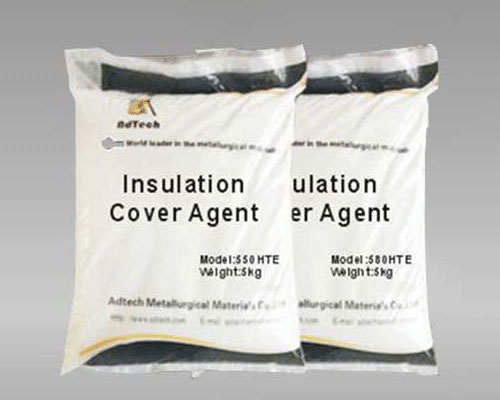
AdTech manufactures two standard covering flux types to address different alloy families and specific metallurgical requirements:
550CF — Standard Covering Flux for Aluminum Alloys
550CF is a sodium-containing (Na type) covering flux designed for general aluminum and non-high-magnesium aluminum alloy covering in the furnace. It provides excellent surface protection, reduces oxidizing burning loss, and prevents hydrogen absorption during melting and holding operations.
Best suited for: Pure aluminum (1xxx), Al-Mn alloys (3xxx), Al-Si alloys (4xxx), standard Al-Mg-Si alloys (6xxx with Mg <2%), and Al-Zn alloys (7xxx) where sodium presence is acceptable.
580CF — Sodium-Free Covering Flux for High-Mg and Sr-Modified Alloys
580CF is a sodium-free (Na free type) covering flux specifically formulated for high-magnesium aluminum alloys and strontium-modified aluminum alloys. In these alloy systems, sodium is a harmful contaminant — even trace amounts of Na cause edge cracking in high-Mg alloys during rolling and reduce the effectiveness of strontium modification in foundry alloys. The 580CF formulation provides the same dense surface protection as 550CF while avoiding sodium contamination entirely.
Best suited for: Al-Mg alloys (5xxx series — 5083, 5182, 5754, 5052), strontium-modified A356 and A357 foundry alloys, and any alloy where sodium content is specified below 5 ppm.
Table 1: AdTech Covering Flux Specifications
| Property | 550CF | 580CF |
|---|---|---|
| Type | Sodium-containing (Na type) | Sodium-free (Na free type) |
| Function | Prevents melt surface oxidation and hydrogen absorption | Prevents melt surface oxidation and hydrogen absorption |
| Application | Aluminum, non-high-Mg alloy covering in furnace | High-Mg alloy, Sr-modified alloy covering in furnace |
| Dosage | 0.5–1.5 kg per tonne of aluminum | 0.5–1.5 kg per tonne of aluminum |
| Refining Temperature | 720–740°C | 720–740°C |
| Key Benefit | Reduces oxidation burning loss | Eliminates sodium contamination risk while reducing metal loss |
Formulations developed by AdTech metallurgical engineering team. Dosage recommendations based on standard furnace geometry and holding conditions. Actual dosage may vary with furnace size, holding time, and atmospheric humidity.
AdTech Covering Flux
Why Is Covering Flux Necessary During Aluminum Melting?
Anyone who’s run an aluminum furnace without covering flux knows the answer to this question instinctively — even if they haven’t quantified it.
Aluminum is among the most reactive common metals when molten. The oxidation reaction (4Al + 3O₂ → 2Al₂O₃) is thermodynamically favorable at every temperature above the melting point, and the presence of moisture accelerates the process while simultaneously introducing hydrogen into the melt. The oxide film that forms on an unprotected melt surface isn’t purely protective like the passive oxide on solid aluminum — at furnace temperatures, it’s continuously growing, cracking, reforming, and entrapping metal within the dross layer.
Here’s what happens without adequate melt surface protection:
- Oxidation burning loss increases — Every kilogram of aluminum that converts to Al₂O₃ is a kilogram you melted, paid energy for, and cannot sell. In large holding furnaces, unprotected surfaces can lose 2–5% of metal charge to oxidation per holding cycle.
- Hydrogen pickup accelerates — Atmospheric moisture reacts with the aluminum surface (2Al + 3H₂O → Al₂O₃ + 3H₂), with the hydrogen dissolving directly into the melt. This increases the burden on your downstream degassing unit and may push hydrogen levels beyond what inline degassing can adequately correct.
- Inclusion content rises — Oxide films and fragments that form on an unprotected surface get folded into the melt during charging, stirring, and transfer operations. These non-metallic inclusions persist through the melt treatment line and end up in your castings.
- Dross volume grows — More oxidation means more dross, which means more skimming, more metal trapped in dross, and higher dross processing costs.
Covering flux breaks this cycle at the source. The protective film it forms is far more effective than the natural oxide layer alone — it’s continuous, fluid, self-healing when disturbed, and chemically stable at furnace operating temperatures.
How Does Aluminum Covering Flux Work?
The mechanism is straightforward but the formulation chemistry matters more than most people realize.
When covering flux powder is spread across the molten aluminum surface, it absorbs heat from the melt and melts itself — forming a liquid layer that flows across the entire surface area. The key properties that make this effective are:
Low melting point — Covering flux formulations are designed to melt at temperatures below the aluminum holding temperature (typically 650–700°C), ensuring rapid formation of the protective layer when applied to metal at 720–740°C.
Low viscosity and good fluidity — Once molten, the flux spreads quickly and evenly. A good covering flux doesn’t sit in clumps — it flows across the surface and fills in gaps, including areas disturbed by charging or stirring operations.
Chemical stability — The flux layer must remain stable at furnace operating temperatures for extended holding periods without decomposing, reacting with the aluminum, or generating fumes that create workplace issues.
Non-wetting behavior with aluminum — The flux film sits on top of the melt without mixing into it. When it’s eventually removed during skimming, it separates cleanly from the metal surface, carrying dross with it rather than trapping clean metal.
Moisture-free composition — This is critical and often overlooked. If the covering flux itself contains moisture (from improper heat treatment during manufacturing or poor storage conditions), adding it to the melt introduces the very hydrogen you’re trying to exclude. All AdTech covering flux components are properly heat-treated to remove both adsorbed water and crystal water, and screened to ensure uniform particle size for consistent melting behavior.
How Much Covering Flux Should You Use Per Tonne?
Dosage seems simple — 0.5 to 1.5 kg per tonne of aluminum — but getting it right matters. Too little and you leave gaps in the protective layer. Too much and you waste money on excess flux without additional benefit, plus you generate more flux-contaminated dross that has to be processed.
The right dosage depends on several practical factors:
- Furnace surface area to volume ratio — A wide, shallow holding furnace exposes more surface area per tonne of metal than a deep crucible. More surface area requires more flux for complete coverage.
- Holding time — Longer holding periods (common in foundries waiting for ladle turnaround or managing scheduling delays) require thicker flux layers or periodic re-application as the original layer thins through evaporation and disturbance.
- Furnace atmosphere — Gas-fired furnaces with direct flame impingement on the melt surface create more aggressive oxidation conditions than electric resistance furnaces. Higher aggressiveness means you’ll benefit from dosages toward the upper end of the range.
- Alloy reactivity — High-magnesium alloys (5xxx series) oxidize more aggressively than pure aluminum or 6xxx alloys because magnesium preferentially oxidizes at the surface. These alloys typically need 1.0–1.5 kg/tonne rather than the minimum 0.5 kg/tonne.
Our practical recommendation: Start at 1.0 kg/tonne for your first application. Observe the coverage — you should see a complete, even liquid film across the entire melt surface with no exposed aluminum. Adjust up or down from there based on coverage quality. When in doubt, re-apply a light dusting (0.2–0.3 kg/tonne) if you see bare metal appearing during extended holding.
Request A Quote
How to Use Covering Flux in Aluminum Melting Operations
Covering flux fits into a specific sequence within the overall aluminum melting and treatment process. Getting the sequence right matters — each step builds on the previous one.
Step 1: Refining
When the aluminum alloy temperature reaches approximately 660–720°C, add the refining agent . Press the degassing tool to the bottom of the melt until no bubbling occurs. The refining step is primarily used to remove dissolved hydrogen from the aluminum liquid within the furnace.
Step 2: Slagging
After refining is complete, add the slagging agent. Stir thoroughly with tools to bring non-metallic inclusions and impurities to the surface, then skim the resulting slag. This step removes solid impurities that were loosened or separated during the refining process.
Step 3: Covering
After slag is cleaned from the surface, spread covering flux (such as AdTech 550CF or 580CF) evenly across the entire melt surface. The flux melts and forms a dense protective layer that prevents hydrogen from re-entering the aluminum liquid from the atmosphere and provides thermal insulation to reduce temperature loss.
Step 4: Furnace Cleaning
After the melting campaign is complete and all aluminum has been tapped, use deslagging flux to remove residual buildup from the furnace walls and floor, maintaining refractory integrity and preventing contamination of subsequent heats.
Application method: Covering flux can be applied by hand-spreading across the melt surface using a long-handled spoon or scoop, ensuring even distribution. For larger furnaces, it can also be dispersed using a gas-powered spreader for more uniform coverage. The flux should not be plunged into the melt — it is a surface treatment only.
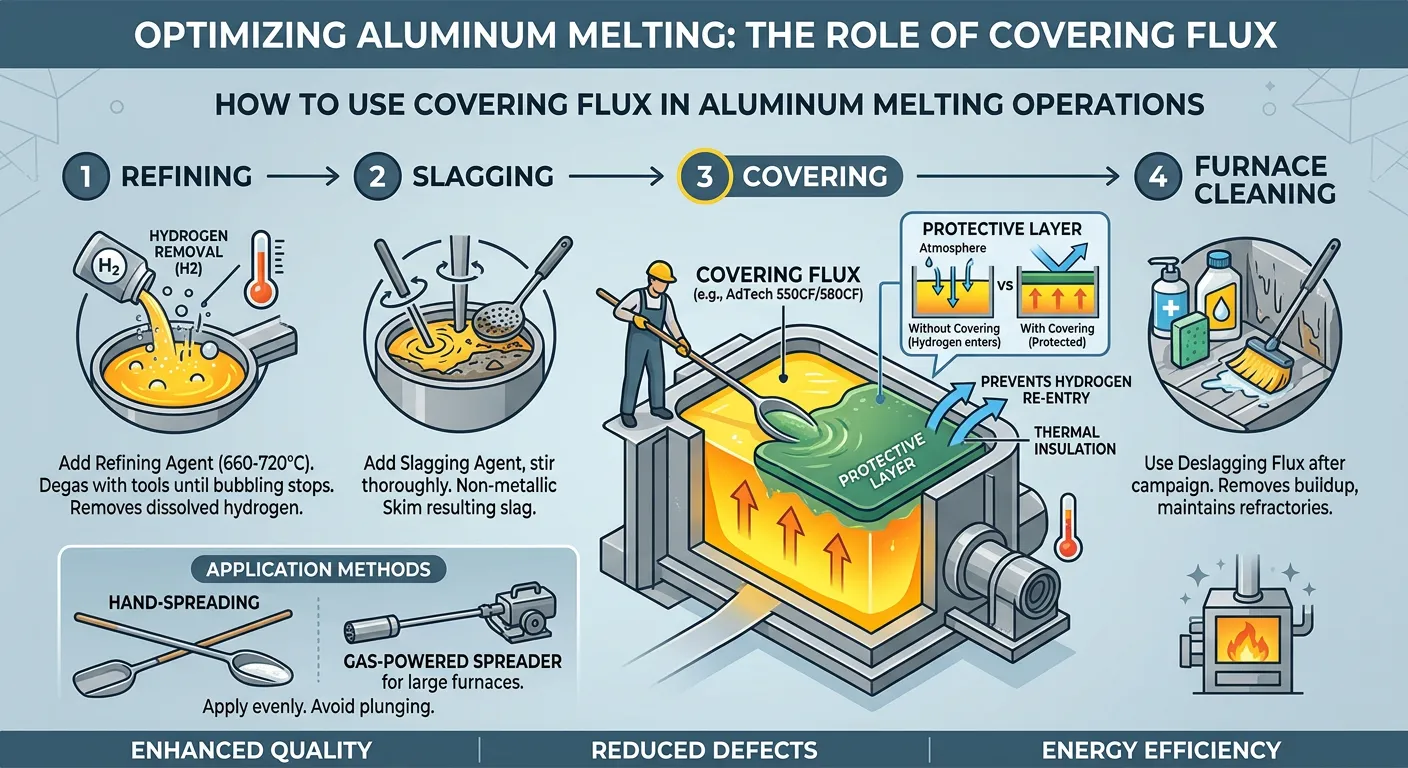
How to Use Covering Flux in Aluminum Melting Operations
What Happens If You Use the Wrong Type of Covering Flux?
This is a question that doesn’t get asked often enough, and the consequences of getting it wrong can be expensive.
The most common mistake is using a sodium-containing flux (like 550CF) on high-magnesium alloys or strontium-modified foundry alloys. Here’s why that’s a problem:
Sodium in high-Mg alloys (5xxx series): Sodium causes hot shortness — intergranular cracking during hot rolling or extrusion. Even 5–10 ppm of sodium in alloys like 5182 or 5083 can render the metal unsalvageable for its intended application. If your covering flux contains sodium compounds, trace amounts will migrate into the melt during the holding period. The Aluminum Association’s guidelines on alkali metal limits in 5xxx alloys specify maximum Na content well below 10 ppm for most applications.
Sodium in Sr-modified foundry alloys: Strontium modification refines the eutectic silicon structure in A356/A357 alloys, which is critical for ductility and fatigue performance. Sodium interferes with strontium modification — it competes for the same modification sites and produces an unstable, inconsistent eutectic structure. The result is castings with unpredictable mechanical properties.
This is exactly why AdTech offers the 580CF sodium-free formulation as a distinct product. It’s not a premium upsell — it’s a metallurgical necessity for these alloy families.
Table 2: Covering Flux Selection Guide by Alloy Family
| Alloy Family | Series | Key Concern | Recommended Flux | Reason |
|---|---|---|---|---|
| Pure aluminum | 1xxx | General oxidation protection | 550CF | Standard protection, Na acceptable |
| Al-Cu | 2xxx | General oxidation protection | 550CF | Na tolerance adequate |
| Al-Mn | 3xxx | Oxidation + Na control for can stock | 580CF (for 3004/3104) or 550CF | Can stock requires Na-free |
| Al-Si | 4xxx | General oxidation protection | 550CF | Standard protection adequate |
| Al-Mg (high Mg) | 5xxx | Na causes hot shortness | 580CF (required) | Na must be excluded |
| Al-Mg-Si | 6xxx | General oxidation protection | 550CF | Na tolerance adequate for most |
| Al-Zn | 7xxx | General oxidation protection | 550CF or 580CF | Application dependent |
| Sr-modified foundry | A356/A357 | Na destroys Sr modification | 580CF (required) | Na must be excluded |
Selection guidance based on established aluminum metallurgy principles and alloy-specific alkali metal sensitivity.
Covering Flux Packaging and Storage
Proper storage is just as important as proper application. Flux that absorbs moisture during storage defeats its own purpose — you’d be introducing water directly onto your melt surface.
Table 3: AdTech Covering Flux Packaging Specifications
| Packaging Level | Specification | Details |
|---|---|---|
| Internal Packaging | 2–5 kg per sealed bag | Moisture-barrier sealed bags |
| Carton Packaging | 25 kg per carton | Cardboard carton, sealed |
| Pallet Packaging | 1 tonne per pallet | Stretch-wrapped for transit protection |
| Special Packaging | As per customer requirement | Custom bag sizes, bulk containers available |
| Storage Requirements | Ventilated, dry environment | Shelf life: 6–12 months from manufacture date |
All AdTech flux products are heat-treated during manufacture to remove adsorbed and crystal water. Shelf life assumes intact packaging stored per recommended conditions.
Storage tips from field experience:
- Store flux pallets off the ground on racks or wooden pallets — concrete floors in casthouses absorb and release moisture, especially in humid climates.
- Once a bag is opened, use the contents within 48 hours or reseal the bag tightly. Partially used bags left open next to the furnace will absorb moisture rapidly.
- In tropical or high-humidity regions (Southeast Asia, coastal Middle East, Central America), consider climate-controlled storage or smaller bag sizes to ensure each bag is consumed quickly once opened.
- Check flux condition before use — if the powder has clumped, caked, or changed color, it has absorbed moisture and should be discarded or re-dried before use.
AdTech Real Case: Reducing Melt Loss at an Indian Secondary Smelter
In early 2023, we began working with a secondary aluminum smelter located in Jamnagar, Gujarat — one of India’s most active aluminum recycling regions. The operation processed mixed aluminum scrap (extrusion offcuts, automotive castings, UBC) into remelted billets and foundry ingots, primarily A356 and LM25 for the domestic automotive and two-wheeler casting industry.
Their situation before contacting AdTech:
The plant operated three gas-fired reverberatory furnaces with a combined capacity of approximately 15 tonnes per heat. Their melt treatment practice was rudimentary — they used a locally sourced covering flux of uncertain composition, applied inconsistently, with no sodium-free option available. Refining was done with a basic chlorine tablet system. No inline degassing or filtration equipment was installed. Metal was transferred by ladle directly from the furnace to the casting station.
The problems were costing them real money:
- Reported melt loss averaged 5.8% per heat — significantly above the 2–3% benchmark for a well-run secondary smelter
- Dross analysis showed high metallic aluminum content (55–65%), meaning they were throwing away good metal trapped in poorly formed dross
- Their A356 castings for a major two-wheeler manufacturer were failing strontium modification checks — the eutectic silicon structure was inconsistent and coarse in approximately 20% of heats
- Root cause investigation revealed their existing flux contained sodium compounds, which were interfering with their strontium modification practice
What AdTech supplied:
- 580CF sodium-free covering flux — initial order of 5 tonnes for trial, with monthly supply thereafter
- Refining flux (AdTech tablet and powder refining agents) for in-furnace hydrogen removal
- 1× single-rotor online degassing unit (15 MT/H) with Si₃N₄ rotor for their primary casting line
- 1× CFF filter box with 30ppi ceramic foam filters
- Technical support including 6 days of on-site process optimization
What our team found and fixed:
The first thing our field engineer noted was flux application practice. Operators were adding covering flux in large piles at one corner of the furnace surface rather than spreading it evenly. Large areas of the melt surface had no coverage at all while other areas had excess flux pooling and generating fume. We restructured their application procedure — even spreading at 1.0 kg/tonne immediately after skimming, with re-application of 0.3 kg/tonne every 45 minutes during extended holding periods.
The switch from their sodium-containing local flux to AdTech 580CF resolved the strontium modification issue almost immediately. Within the first week of the trial, Sr modification consistency improved from ~80% to over 97% of heats meeting specification. The two-wheeler manufacturer’s quality team confirmed the improvement within the first month.
Melt loss told the most compelling story. With proper 580CF application combined with improved skimming practice (skim less aggressively, allow dross to dry on the surface before removal, use a perforated skimmer to drain metal back into the furnace), their melt loss dropped from 5.8% to 3.1% per heat — a 47% reduction.
On a 15-tonne heat at average scrap prices of approximately $2,200/tonne (Indian market rate for sorted casting alloy scrap in 2023), that 2.7% melt loss improvement represented roughly $890 saved per heat. Running three furnaces at two heats per day, the monthly savings from melt loss reduction alone exceeded $160,000. The cost of AdTech 580CF covering flux for the same period was approximately $4,500.
The degassing unit and filtration system further improved their casting quality, reducing porosity-related rejections from the two-wheeler customer and opening the door to supplying more demanding automotive casting applications that they’d previously been locked out of due to quality limitations.
Eighteen months into the relationship, this customer now orders AdTech covering flux (580CF), refining flux, ceramic foam filters, and degassing unit consumables on a regular monthly schedule. Their purchasing manager told us during a recent visit: “The flux alone paid for everything else.”
AdTech Metallurgical Materials Co., Ltd. is a Sino-foreign joint venture that provides filter materials and complete sets of purification equipment to global aluminum alloy companies.
How Does Covering Flux Fit Into a Complete Melt Treatment System?
Covering flux is the first line of defense in melt quality — it works inside the furnace, before the metal ever reaches the treatment line. But it’s only one component of a comprehensive approach.
The complete AdTech melt treatment sequence:
- Covering flux — Applied in the furnace to protect the melt surface during melting and holding
- Refining flux — Used in-furnace for initial hydrogen removal and alkali metal reduction
- Inline degassing unit — Rotary degassing in the launder system for precise hydrogen control
- Ceramic foam filter — Final inclusion removal before the casting station
- Ceramic fiber insulation — Thermal management throughout the launder and treatment line
Each step addresses a specific contamination mechanism. Covering flux prevents the problem from growing worse during holding. Refining flux actively attacks contaminants inside the furnace. Degassing removes dissolved hydrogen that made it past the first two barriers. Filtration catches solid inclusions that survive the entire upstream process.
Skip covering flux and your downstream equipment works harder, costs more to operate, and still may not fully compensate for the oxidation and hydrogen pickup that occurred during unprotected holding.
Contact us for a complete aluminum melt treatment solution.
FAQ
1. What is covering flux used for?
Covering flux is used to protect the surface of molten aluminum from oxidation and hydrogen absorption during melting and holding.
2. How does covering flux work?
After it melts, covering flux forms a dense protective layer on the molten aluminum surface, helping block air, moisture, and oxidation.
3. Why is covering flux important in aluminum melting?
It helps reduce metal loss, lower dross formation, improve melt cleanliness, and protect casting quality.
4. What is the dosage of covering flux?
The recommended dosage is usually 0.5–1.5 kg per ton of molten aluminum, depending on furnace conditions and alloy type.
5. What is the difference between 550CF and 580CF?
550CF is a standard Na-type covering flux for regular aluminum alloys. 580CF is a sodium-free type designed for high-magnesium and strontium-modified aluminum alloys.
6. Can covering flux reduce oxidation burning loss?
Yes. One of the main functions of covering flux is to reduce oxidation burning loss on the molten metal surface during furnace holding.
7. Is covering flux suitable for high-magnesium aluminum alloys?
Yes, but you should use a sodium-free covering flux, such as AdTech 580CF, for high-magnesium alloys.
8. How should covering flux be applied?
It can be sprinkled directly and evenly on the molten aluminum surface after slag removal, so it can quickly form a protective film.
9. How should covering flux be stored?
It should be stored in a dry, ventilated place. The usual shelf life is 6 to 12 months if the packaging remains sealed.
10. Can covering flux be used with other aluminum melting materials?
Yes. It is commonly used together with refining flux, slagging agents, degassing units, and ceramic foam filters as part of a complete melt treatment process.